If you're reading this at 3 a.m. with a baby who will only sleep on your chest, you're in good company. "When should I start sleep training my newborn?" is one of the most common questions new parents ask, and the honest answer on when to start sleep training newborn babies has two parts: formal baby sleep training usually starts around 4 to 6 months, but the foundations for good sleep can be laid from the very first weeks.
That two-part idea is the heart of Tracy Hogg's The Baby Whisperer. Hogg was a British nurse who specialised in maternity and newborn care, and her approach sits deliberately in the middle ground: no leaving young babies to cry, but no letting the household slide into chaos either. Instead, she taught a predictable daily routine from early on, gentle settling techniques matched to the baby's age, and an eye for habits you'll later have to undo.12
In this guide you'll find what sleep training a newborn really means, Hogg's age-by-age approach, a sample newborn sleep schedule, the sleep training methods available from four months, and what the research says about safety.
When to start sleep training newborn babies: the short answer
- 0–6 weeks: No training. Feed on demand, learn your baby's cues, and begin a loose routine.
- 6 weeks–4 months: "Sleep shaping." A consistent routine and wind-down, putting your baby down drowsy but awake, and gentle settling such as Hogg's shush-pat.
- 4–6 months and beyond: Formal baby sleep training becomes an option if you want it, such as Hogg's Pick Up/Put Down or other methods.
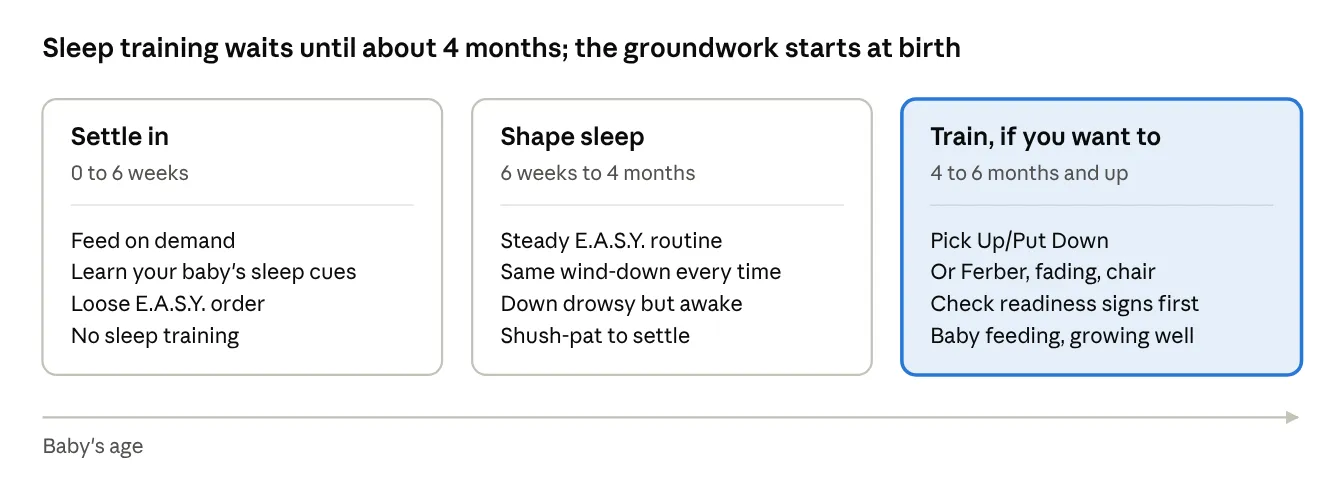
Most paediatric sleep experts put the start of formal training at 4 to 6 months. Hogg herself reserved Pick Up/Put Down for babies of roughly four months and older, because being repeatedly lifted and lowered is too stimulating for younger infants; for them she used shush-pat instead.23 If your baby was born early, use their corrected age, and check with your doctor or health visitor first if there are any concerns about feeding or weight gain.
Why newborns aren't ready for formal sleep training
Newborns need around 14 to 17 hours of sleep in every 244, but it comes in short bursts. Their stomachs are tiny, they need frequent feeds, and their internal day–night rhythm hasn't developed yet. Waking at night to eat is biology, not a bad habit.
So newborn sleep training in the strict sense, teaching a baby to sleep long stretches without help, isn't realistic or appropriate in the first months. What is realistic is the Baby Whisperer's approach: give the day a predictable shape, and avoid building sleep habits by accident.
The Baby Whisperer foundation: E.A.S.Y.
Hogg's routine is summed up in the acronym E.A.S.Y.: Eat, Activity, Sleep, and time for You.12 When your baby wakes, you feed them; then comes a short period of awake time; then sleep; and while they sleep, you get a moment for yourself.
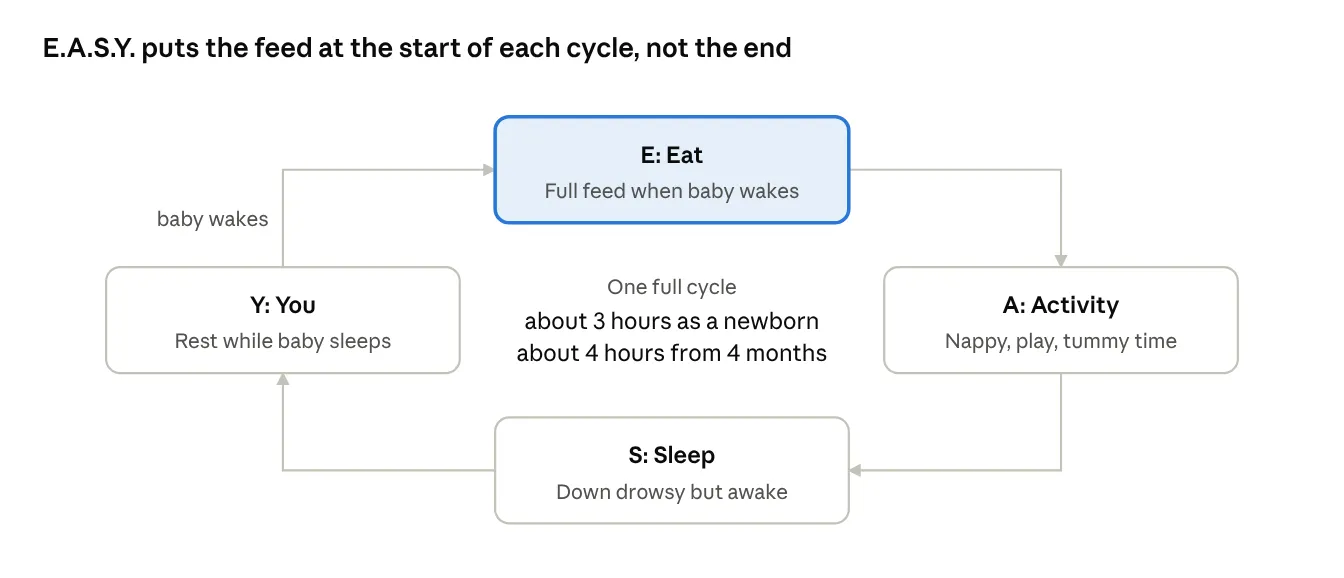
Hogg was clear that this is a routine, not a clock-driven schedule. You follow a consistent order of events rather than rigid times. As she put it, with E.A.S.Y. "you don't follow the baby; you take charge".2
Why does the order matter for sleep? Because it separates feeding from falling asleep. If a baby always feeds to sleep, the breast or bottle becomes the only way they know how to drift off, and they'll look for it at every night waking. Feeding at the start of the cycle gently breaks that link.
Hogg called the opposite pattern "accidental parenting": habits that start because they work in the moment, such as rocking, feeding to sleep or car rides around the block, and which the baby then comes to depend on.2 She wasn't against comfort. She simply encouraged parents to notice which habits they'd be happy to keep at six months, and which they wouldn't. She also asked parents to go S.L.O.W. (Stop, Listen, Observe, then work out What's up) before rushing in at the first whimper.1
A sample newborn sleep schedule (E.A.S.Y. style)
In Hogg's books, young babies typically run on a cycle of about three hours, moving towards a four-hour cycle at around four months.12 Use this as a guide rather than a stopwatch:
| Age | E.A.S.Y. cycle | Typical awake time (incl. feed) | Settling approach |
|---|---|---|---|
| 0–6 weeks | ~2.5–3 hours | 30–60 minutes | Feed on demand, cuddle, shush-pat |
| 6 weeks–4 months | ~3 hours | 60–90 minutes | Wind-down ritual, drowsy but awake, shush-pat |
| 4–6 months | ~4 hours | 1.5–2 hours | Pick Up/Put Down or another method if needed |
Example day for a two-month-old on a three-hour E.A.S.Y. routine:
- 7:00 Eat, then 7:30 Activity (nappy, tummy time, a chat), then 8:15 Sleep
- 10:00 Eat, Activity, Sleep
- 13:00 Eat, Activity, Sleep
- 16:00 Eat, Activity, short nap
- 17:00–19:00 Closer evening feeds ("tanking up"), bath, bedtime around 19:00
- 22:00–23:00 Dream feed, then night feeds as needed
Hogg suggested clustering feeds in the early evening and adding a dream feed late in the evening to help stretch the first part of the night.12
Newborn sleep tips from the Baby Whisperer (0–4 months)
- Watch for sleep cues. Yawning, staring into space and jerky limb movements all signal tiredness. Hogg advised starting the wind-down at the first yawn, since by the third your baby may already be overtired.1
- Use the same wind-down every time. Dim the room, swaddle (stop as soon as your baby shows signs of rolling), and hold them quietly for a few minutes. Repetition becomes the cue that sleep is coming.
- Put your baby down drowsy but awake. This lets them experience the last bit of falling asleep in their own sleep space, which is the skill everything else builds on.
- Try shush-pat. Hold your baby on your shoulder, pat steadily in the centre of their back like a heartbeat, and make a firm "shhh" sound near their ear. Once they calm, lay them down and keep patting until they settle, then stop.2 You stay with your baby throughout; this is not crying it out.
- Keep nights boring. Use low light and little talking, and do night feeds calmly and quickly, so your baby starts to learn the difference between day and night.
- Never compromise on safe sleep. The American Academy of Pediatrics recommends placing babies on their back for every sleep, on a firm, flat surface with nothing else in it, and room-sharing without bed-sharing, ideally for at least the first six months.5
Sleep training methods from around four months
By four months many babies' sleep has matured enough for longer night stretches, and this is when structured sleep training methods become appropriate.
Pick Up/Put Down (Tracy Hogg)
Hogg's signature technique for babies of about four months and older23:
- Do your usual wind-down, then place your baby in the cot awake.
- If they fuss, try shush-pat first, with a hand on their tummy or back.
- If crying escalates, pick them up and comfort them until they're calm, not until they're asleep, then put them back down.
- Repeat as many times as needed.
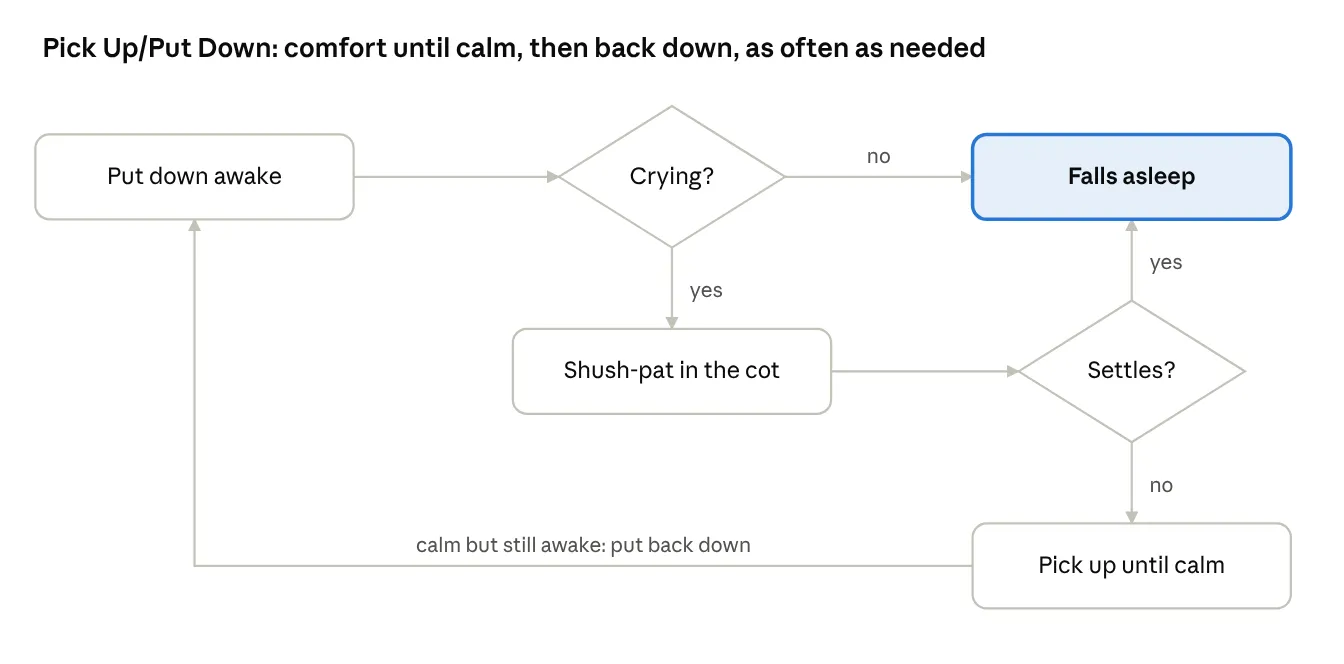
It's gentle but labour-intensive: the first nights can take a lot of repetitions. Healthline notes it tends to work best between about 4 and 8 months.3 For older babies, Hogg adapted it so that you use your voice and touch first and pick up less often.
Other common sleep training methods
- Graduated extinction (Ferber, controlled crying): Brief check-ins at gradually increasing intervals.
- Bedtime fading: Temporarily moving bedtime later to when your baby naturally falls asleep, then gradually bringing it earlier.
- Chair method (camping out): Sitting beside the cot and moving the chair further away over several nights.
Is baby sleep training safe? What the research says
Two well-known trials are reassuring for parents of older babies:
- In a 2016 randomised trial of 43 infants aged 6–16 months, both graduated extinction and bedtime fading reduced the time it took babies to fall asleep, and graduated extinction also reduced night wakings. Researchers found no increase in infant stress and no differences in attachment or emotional and behavioural problems at 12 months.6
- A 2012 five-year follow-up of 326 children, whose families had received behavioural sleep help (such as controlled comforting and camping out) at 8–10 months, found no lasting harms or benefits to children's emotional health, behaviour, parent–child relationship or mothers' mental health at age six.7
Two caveats are worth knowing. These studies involved babies of six months and older, not newborns, and they tested other methods rather than Pick Up/Put Down specifically. Hogg's technique has been studied far less, though it keeps the parent present and responsive throughout. The fair takeaway is that, at the right age, a structured approach is a reasonable choice, and so is choosing not to sleep train at all.
Signs your baby is ready for sleep training
- They're around 4 months or older (corrected age if premature).
- They're feeding well and gaining weight, and your doctor is happy.
- They already manage at least one longer stretch at night.
- They're not unwell, teething hard or in the middle of a big change such as travel or starting childcare.
- You have the energy to be consistent for a week or two.
Frequently asked questions
When should I start sleep training my newborn? Formal sleep training is generally recommended from around 4 to 6 months. Before that, focus on a predictable routine, a consistent wind-down and gentle settling.
Can you sleep train a newborn? Not in the "cry it out" sense. But you can shape newborn sleep with an E.A.S.Y. routine, drowsy-but-awake put-downs and shush-pat.
What's the best sleep training method? The one you can apply consistently. Pick Up/Put Down suits parents who want to stay hands-on; graduated extinction tends to work faster but involves more crying.
Can I start E.A.S.Y. from birth? Hogg encouraged starting a routine from the first days home, applied flexibly. Newborns still feed whenever they're hungry; you're simply keeping the order of eat, activity, sleep.
Make E.A.S.Y. easier. Tracking feeds, naps and wake windows on four hours' sleep is hard. Little Duckling gives you an age-based E.A.S.Y. schedule, helps you move from accidental parenting to a routine that works, and lets both parents log as they go. Start free today.
This article is for general information and isn't a substitute for advice from your doctor, midwife or health visitor.